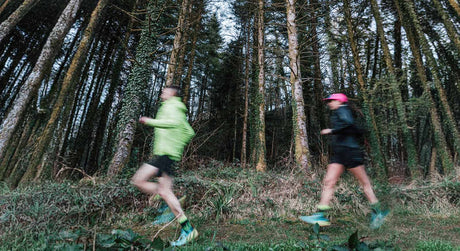
Taking part in the Marathon des Sables®, the Oman Desert Marathon®, or the Raidlight Desert Trophy isn’t just about endurance. Sand, heat, carrying gear, and repeated efforts require specific physical preparation, even for seasoned trail runners.
To support you best, we called on Matthieu Andreux, sports coach and Raidlight ambassador. Specialized in preparing long-distance trail runners, Matthieu shares his concrete, field-tested advice here.
👉 Discover our kit dedicated to desert races with 30% off when you buy 4 products.
Strengthen your body for the sand
Sand tires you out. It absorbs your push, destabilizes you, breaks your rhythm. So you have to strengthen the right muscle groups to gain power and stability.
Areas to target:
- Ankles and calves: for propulsion and balance on loose ground
- Quadriceps and glutes: for dune climbs and bursts
- Core: to keep a solid posture even when tired
Recommended exercises:
- Step-ups on a bench with weight
- Dynamic planks, glute bridges
- Plyometric jumps on sand
- Ankle strengthening
💡 Tip: do a sand run every week to get your footing used to instability.
Work on strength endurance
In the desert, you run loaded, for a long time, often under 40°C. You need to train your body to repeat the effort over several hours.
Goals:
- Delay muscle fatigue
- Improve recovery between stages
Key sessions:
- Long outings (3 to 6h) with a progressively heavier backpack
- Repeated climbs on sand or gentle slopes
- Functional circuits: squats, lunges, dynamic core work
Example block:
- 20 min warm-up
- 30 min sand climbs (3 min effort / 1 min rest, x6)
- 20 min strength training
- 10 min cool down
Learn to run in the heat
The heat changes everything: your heart races, you dehydrate fast, you lose power. So you need to train your body to handle these conditions.
Acclimation strategies:
- Run with several layers of clothes or in a heated room
- Post-sauna sessions to get your body used to it
- Start with 30-45 min and build up to 90 min
- Drink 150-250ml every 15-20 min while testing your sports drinks
👉 Goal: reduce heat stress and improve effort management in real conditions.
Optimize your stride to save energy
In sand, every step costs. You need a low, steady, economical stride. The goal: limit energy loss.
Useful tips:
- Aim for a cadence of 180 steps/min for better efficiency
- Practice changing your pace depending on the ground texture (slow 4x4 phase vs quick acceleration)
- If possible, train in the snow: same instability, same effort
Eccentric focus:
- To prepare for dune descents (e.g., eccentric squats)
- Improves muscle control and prevents injuries
👉 If you’re looking for gear that protects you from the sun, we’ve got what you need: UV-protective clothing.
Structure your preparation over 12 weeks
A good plan includes adaptation, specialization, and tapering phases. Here’s a model tested by Matthieu Andreux:
Weeks 1 to 4: Base
- General strengthening, basic endurance
- Moderate long runs
- Weekly proprioception
Weeks 5 to 8: Specific
- Training on sand / unstable terrain
- Long runs with pack + simulated heat
Weeks 9 to 12: Pre-competition
- Back-to-back long runs over 2 days
- Volume reduction as the race approaches
Want to go further?
Matthieu has prepared a free 12-week training plan for you, specially made for desert racing. Built to boost your performance and improve your recovery between stages.
Download the training plan here.
You want to know more about the Raidlight Desert Trophy? All the info here.