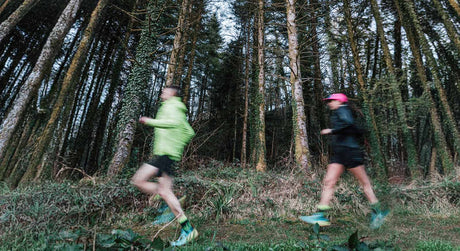
A cramp in the middle of a climb or on a technical descent can quickly turn your race into a struggle. And contrary to common belief, it’s not just a magnesium deficiency problem.
On trails, cramps are almost always linked to a mix of muscle fatigue, poorly managed hydration, and electrolyte imbalance. The idea isn’t to look for a miracle solution but to understand what’s happening to better anticipate it.
Why you get cramps on trails
On the trail, cramps rarely happen by chance. They often appear after several hours of effort, when the body starts to saturate.
The first factor is muscle fatigue. Uphill, you continuously engage the same muscle groups. Downhill, you endure repeated eccentric contractions. If you’re not prepared, the muscles eventually “give out.”
Next, there’s hydration and electrolytes. When you sweat, you lose sodium and other essential minerals. If you only drink water, you dilute this balance even more.
Finally, more mechanical factors come into play: inefficient stride, lack of relaxation, unsuitable gear, or poor effort management.
Hydration: the most often mismanaged basic
Most cramps on trails are linked to poorly calibrated hydration: either you don’t drink enough, or you drink poorly (too much water, not enough minerals).
The goal is not to drink a lot, but to drink regularly and smartly.
Before the race
Start hydrated. Drink gradually in the hours before, without overloading at the last moment. If you know you sweat a lot, adding electrolytes beforehand can already make a difference.
During the effort
Drink in small sips, regularly. On trails, a realistic baseline is around 150 to 250 ml every 15 to 20 minutes, adjusted according to heat and your effort.
The classic mistake is to drink only water. For longer formats, it’s more effective to include an isotonic drink that provides both hydration and minerals.
An isotonic drink helps maintain your hydration while compensating for electrolyte losses. On trails, it’s often the simplest solution to avoid imbalances.
View the range

To easily carry your drink, the choice of container also affects your consistency.
A soft flask with a tube lets you drink without breaking your rhythm. This is often what makes the difference between theoretical hydration… and truly effective hydration during a race.
Current offer: 2 + 1 flask free.
Take advantage of the offer
After effort
Recovery starts right after the race. Rehydrate with mineral-rich waters or suitable recovery solutions to rebalance your body.
Electrolytes: useful, but not magical
Electrolytes (sodium, potassium, magnesium) play a key role in muscle contraction. In trail running, their loss through sweat can promote cramps if not compensated.
But beware: taking them without a strategy doesn’t help much. The point is to include them within an overall hydration plan.
Easy to carry, they allow you to easily adjust your mineral intake depending on heat, duration, and your sweat level.
View product
Nutrition: avoid the energy slump that triggers cramps
A cramp often comes at the end of the race… when you’re already in an energy deficit. Maintaining a steady intake of carbohydrates helps limit this overall fatigue.
The idea isn’t to eat a lot, but to eat regularly and in a digestible way.
Easy to consume even during intense effort, it quickly provides energy without overloading digestion.
Discover gels
Training remains the number one factor
You can optimize your hydration and nutrition, but if your muscles aren’t prepared, cramps will eventually come.
The key work remains gradual adaptation: long runs, elevation gain, descents, accumulated fatigue. This is what allows your body to handle the load without overload.
Muscle strengthening and proprioception also play an important role in improving stability and limiting unnecessary tension.
In summary
Cramps in trail running don’t come from a single factor. They appear when several elements combine: fatigue, poor hydration management, lack of energy.
To avoid them, you need to build a simple but coherent strategy: drink regularly, take electrolytes, eat properly, and prepare your body for the effort.
It’s this consistency, more than one-off solutions, that makes the difference on long outings.