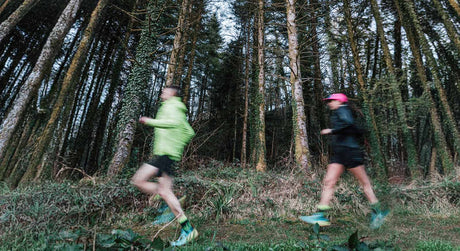
Uphill, they help you move forward. Downhill, they stabilize your stride. But between sections… where do you store them without losing time or breaking your rhythm?
Quiver, belt, or integrated pack system: each solution has its advantages. The right choice mainly depends on your practice, your terrain, and your usage frequency.
The goal is simple: to be able to grab and store your poles without thinking, even when tired, even during the race.
Quiver, belt, or pack: how to carry your trail poles?
Before comparing solutions, ask yourself a simple question: how often do you use your poles during your outing?
If you often switch between walking, accelerating, and technical sections, you need a fast and accessible system. If you use them rarely, the priority becomes stability and discretion.
The trail quiver: the smoothest option during the race
The quiver is now the most used solution in trail running, especially for long distances. It attaches to the back of the pack and allows you to store or take out poles without stopping.
On a course with elevation changes, this is often what makes the difference: you adjust your effort without losing time.
Light and simple to use, this quiver allows quick access to poles during the race. Its real advantage: you can handle them without taking off your pack, even while moving.
Ideal if you often switch between carrying and using poles on varied terrain.
Discover the quiver
On the trail, the quiver is especially effective in ultras or mountain runs, where you constantly have to adapt to the terrain.
How to use a quiver properly
Always point the tips downward to make them easier to take out. Adjust the height to avoid interfering with your shoulders or bouncing.
The most important thing: repeat the motion during training. During the race, you should be able to store and take out your poles without thinking.
The trail belt: minimalist and effective
If you run light, without a pack, the belt becomes an interesting solution. It allows you to carry the poles close to your body, without adding bulk.
It’s a good option for short formats or fast outings, where you want to stay fluid and minimalist.
Using your belt well
Position the poles horizontally to limit bouncing. Adjust the tension well: too loose, it moves; too tight, it restricts breathing.
Again, test in real conditions: comfort depends a lot on your stride and the terrain.
Integrated carrying on the pack: the discreet solution
Some packs have a built-in carrying system. You don’t need to add anything: the poles attach to the pack, usually at the back or front.
It’s a clean and stable solution, but often a bit slower to handle than a quiver.
This pack includes a pole carrying system directly in its design. Result: stable carrying, no extra accessory, and good weight distribution.
Interesting if you want a simple and well-balanced setup over time.
Discover the pack
This type of carrying works well if you use your poles on specific sections, but not continuously.
The key point: automate the movement
No matter the chosen solution, the real issue remains the same: fluidity.
If you have to think about storing or taking out your poles, you lose time and energy. During a race, you feel it quickly.
Testing before the race: essential
Like with shoes or your pack, your carrying system must be tested in real conditions.
Observe: stability, accessibility, possible discomfort on shoulders or lower back. These are small details at first… but over 3 or 8 hours of running, they become crucial.
In summary
There isn’t a single right solution for carrying your poles in trail running. The right choice mainly depends on your practice and your terrain.
Quiver for fluidity, belt for minimalism, pack for simplicity: the key is to find a system you master perfectly.
Once that’s the case, you no longer waste time… and you fully enjoy what the poles can bring you.