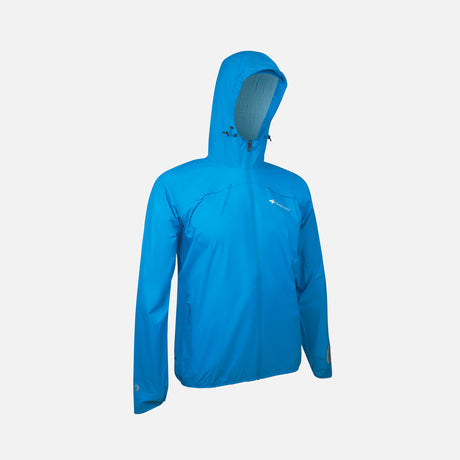
Waterproofness and breathability of clothing are terms often used in descriptions of technical garments, yet few people truly understand what they entail. Although it’s not very complicated, it is necessary to go through some technical explanations that will clarify these concepts and help you choose the garment suited to your needs.
Understanding the performance ratings of waterproofness and breathability
Waterproofness and breathability of a trail running jacket are the two key criteria to watch when buying a rain jacket equipped with specific membranes.
Breathability
Breathability is the ability of a fabric to allow water vapor to escape. A fabric that ensures good breathability limits condensation of water vapor inside the garment. It therefore facilitates the evacuation of sweat and keeps the body dry. There are several ways to measure the breathability of a product.
Depending on weather conditions and the clothes worn, our body regulates its temperature by releasing water through sweat. Moist outside air can also penetrate our clothing. It is therefore essential to wear breathable garments; otherwise, the moisture created will be trapped in the fabric, which will then cool you down. Breathability allows the water vapor to escape to keep you dry.
There are several ways to measure the breathability of a product; here are the two most commonly used measurements:
- The MVP (Moisture Vapour Permeability) measurement calculates the amount of water (in vapor form) that the fabric lets pass through in 24 hours. The higher the value, the better the breathability. MVTR is expressed in g/m²/24h:
- MVP 5,000 = low breathability garment
- MVP 10,000 = breathable garment
- MVP 20,000 = garment with very good breathability
- MVP 40,000 = garment with excellent breathability
- MVP 60,000 = extremely breathable garment
This index is used by most equipment manufacturers.
- The RET (Resistance Evaporative Transfer) index measures a fabric’s ability to let water vapor generated by the body (sweat) escape. Since RET is a resistance index, the lower it is, the more breathable the garment.
- RET above 20: non-breathable
- RET between 12 and 20: low breathability
- RET between 6 and 12: breathable
- RET below 6: very breathable
This index is mainly used by American brands.
Waterproofness
Waterproofness is the ability of a fabric to prevent water penetration. A fabric can be made waterproof by adding a membrane or by applying a coating. To measure a fabric’s waterproofness, it is placed under a tube (column) filled with water, and the height of water at which the first drops pass through the fabric is calculated. The higher the water column, the more waterproof the fabric.
- Schmerber is the unit of measurement for waterproofness.
1 Schmerber = 1 mm water column. A garment with a value of 10,000 Schmerber, i.e., 10,000 mm, resists 10 meters of water! A garment is considered fully waterproof from 20,000 Schmerber upwards.
To assign a waterproofness value to a garment, it undergoes a hydrostatic pressure test with a water column. The test stops when water starts to penetrate the garment. At that point, the height of water it withstood is measured. This value, expressed in millimeters of water column, indicates the fabric’s degree of waterproofness. This testing method (ISO 811) has even become a standard.
For example: 10,000 Schmerber = 10,000 mm water column = often noted as 10K
A waterproof jacket is essential for all outdoor activities and is generally thin, compact, and lightweight, perfect for easy transport.
Understanding the difference between waterproof and water-repellent
A waterproof product protects you against heavy rain, while a water-repellent product only protects you in light drizzle. Water repellency is the property of a fabric on which water beads up and does not penetrate.
Water-repellent products do not have membranes. Water-repellent fabrics are treated with a product that repels water. Water then flows off in droplets and cannot soak into the fabric, so breathability is preserved.
However, a water-repellent treated textile is not designed to withstand immersion or heavy rain. Moreover, over time, wear, and washing, the water-repellent treatment fades.
Our MP+® membrane
In textiles, a membrane refers to a thin, flexible layer that isolates one body from another. For example, in the composition of a waterproof trail running jacket, the membrane makes it waterproof.
Membrane performance is generally measured by two criteria: breathability and waterproofness. At Raidlight, we use MP+® technology (similar to Gore-Tex) which is both waterproof and breathable. Every product equipped with the MP+® membrane is therefore durably waterproof, windproof, and breathable regardless of weather conditions. This means water does not penetrate, cold wind does not pass through, but sweat can still escape.
The MP+® membrane is a technology specially designed to protect users from rain and all weather conditions. The characteristics of the MP+® membrane are:
- High level of waterproofness
- High level of breathability
- Windproof
- Cold resistance
- Durability
The MP+® membrane is a solid, non-microporous membrane. As such, it is completely waterproof, breathable, and windproof. It is made of a hydrophilic polyurethane film with exceptional properties: thanks to its physico-chemical characteristics, it offers you perfect comfort during your outings.
Products equipped with the MP+® membrane provide a three-level protection system to shield you from weather conditions while ensuring optimal comfort: waterproofness, breathability, and wind protection.