When you choose a trail jacket, you often see numbers like 10K, 20K, 25K, or 50K. They sound technical, but they’re mainly there to answer a simple question: will your jacket protect you without turning you into a sauna?
In trail running, a good jacket must handle two challenges at once: keep rain and wind out while letting your sweat escape. It’s the balance between waterproofing and breathability.
Here’s how to read these ratings, understand the difference between waterproof and water-repellent, and choose a jacket truly suited to your activity.
Why are these ratings important in trail running?
In trail running, you’re not static in the rain. You climb, you sweat, you descend, you slow down, you start again. A jacket that protects well from water but breathes poorly can quickly become uncomfortable because moisture stays trapped inside.
Conversely, a very breathable but not waterproof enough jacket might be fine in light drizzle but will show its limits as soon as the rain becomes steady or you’re exposed in the mountains.
Waterproofing: what do 10K, 20K, or 25K mean?
Waterproofing measures a fabric’s ability to prevent water from passing through. It’s often expressed in millimeters of water column, also called Schmerber.
Basically, the higher the number, the more the fabric resists water pressure. A jacket rated 10K means it can withstand a 10,000 mm water column. A 20K jacket resists more and is better suited for long, steady rain or mountain conditions.
Adequate protection against moderate rain. Enough for some short outings or mild weather.
Very good waterproof level. More suitable for long trail runs, mountains, or uncertain weather.
High protection for demanding conditions, prolonged rain, wind, altitude, or mandatory gear in ultras.
The longer and more exposed the run, the more reliable the waterproofing needs to be.
Breathability: the often underestimated factor
Breathability refers to the fabric’s ability to let water vapor produced by your body escape. Simply put: the more your jacket breathes, the less moisture you accumulate inside when you sweat.
This is essential in trail running because you can sweat heavily going uphill, then cool down quickly going downhill or on an exposed ridge. If your jacket holds too much moisture, you can get cold even if the rain doesn’t penetrate.
MVTR, MVP, RET: how to make sense of them?
Brands may use several measures. The most common is MVTR or MVP: it indicates the amount of water vapor the fabric lets pass in 24 hours. The higher the number, the more breathable the fabric.
Another common measure is RET. Here, it’s the opposite: the lower the RET, the better the jacket breathes. An RET below 6 generally corresponds to a very good level of breathability.
| Index | What it measures | How to interpret it |
|---|---|---|
| MVTR / MVP | Amount of water vapor evacuated in 24 hours | The higher the number, the more breathable the fabric |
| RET | Resistance to water vapor passage | The lower the number, the more breathable the fabric |
| 50K | Very high level of breathability | Suitable for intense efforts and long active outings |
Waterproof or water-repellent: they are not the same thing
A water-repellent garment makes water slide off the surface. This is useful in drizzle, light showers, or when you want to limit moisture absorption. But a water-repellent fabric alone is not designed to protect you durably in heavy rain.
A waterproof garment usually uses a membrane or specific construction to prevent water from passing through. This is what you should choose if you’re going to the mountains, running long distances, or if your race requires a waterproof jacket in mandatory gear.
Sufficient for light rain or short outings. Water beads on the fabric, but protection decreases with wear and washing.
Designed to block rain more durably. Ideal for long trail runs, ultras, mountain conditions, or uncertain weather.
The Raidlight MP+® membrane: protection, breathability, and windproofing
At Raidlight, the MP+® membrane is designed to meet trail running needs: protect from rain and wind while allowing moisture produced by effort to escape.
The benefit of a membrane like MP+® is to provide complete protection in changing conditions. It helps keep you dry in the rain, limits cooling caused by wind, and maintains comfort when intensity varies.
Concrete example: Ultralight Jacket 3.0 MP+
For trail or ultra-trail use, a jacket must be protective but also light and compact enough to stay in your bag without weighing you down. It should also be easy to put on quickly if the weather changes.
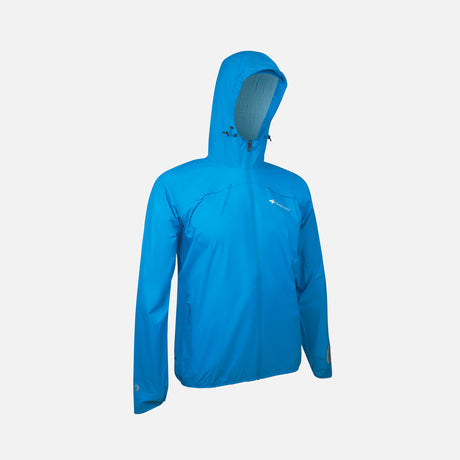
An ultra-light and compact jacket, equipped with an MP+® 25K / 50K membrane. It combines a high level of waterproofness with very strong breathability, and its gusset compatible with packs up to 12 L allows you to wear it over your vest without taking everything off.
Choose this if you want a high-performance jacket for long trail, ultra, unstable weather, or mandatory gear.
View the jacket
Which jacket to choose according to your practice?
The level of waterproofness and breathability you need depends directly on your outing. For a short outing in stable weather, you can sometimes prioritize packability. For a long trail or mountain race, protection becomes much more important.
Priority to lightness, ease of packing, and sufficient protection if the weather remains mild.
Priority to waterproofness/breathability balance, because you will alternate intensity, breaks, climbs, and descents.
Priority to reliability, membrane, weight, packability, and compatibility with your pack.
Priority to protection against rain, wind, and cooling, even if the weather seems good at the start.
Common mistakes to avoid
The first mistake is confusing water-repellent and waterproof. A water-repellent treatment may suffice in light rain, but it does not replace a true waterproof jacket for ultra or mountain use.
The second mistake is choosing a jacket solely based on its waterproof rating. A highly protective but poorly breathable jacket can become uncomfortable as soon as you increase intensity.
The third mistake is never testing your jacket before a race. You need to know how it packs, how it fits, how it behaves with your pack, and if it stays comfortable when you sweat.
In summary: how to read the ratings of a trail jacket?
Waterproofness indicates the jacket's ability to block rain. Breathability indicates its ability to evacuate moisture produced by your effort. In trail running, both are essential.
For committed practice, a high-performance membrane like MP+® helps find this balance: protection against rain and wind, while maintaining good sweat evaporation.
Before choosing, always think about your actual use: duration, weather, altitude, intensity, carried pack, and race rules. This context will tell you what level of protection you really need.