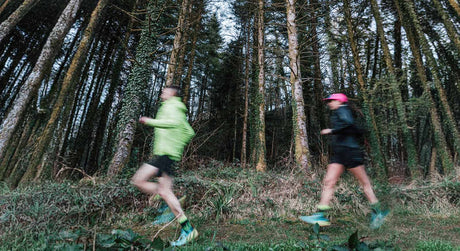
The winter period is often the perfect time to work on your endurance, weaknesses, or technique. Running downhill often seems too difficult or even scary. So, we often try to run all the uphill sections and end up blowing up. To support you in this new season, Nicolas Cerisier, a certified trail running coach and ultra-trail runner, shares his tips to improve both uphill and downhill running.
How to improve uphill?
Practice makes perfect.
To improve uphill, elevation gain (D+) must take an important place in your overall training, even if it means adopting the famous “up & down” or the well-known “hamster” session for runners who only have small hills available.
There are, however, other ways to improve uphill, especially through cross-training: activities that work the strength endurance of the lower limbs. Although this concerns only a small part of trail runners, ski touring is of course a great activity, and cycling in all its forms (road, off-road, home trainer, elliptical) is also a perfect complement.
For specific training, you can of course do hill intervals by exploiting the range of different intensity zones, from very short intervals of a few seconds up to threshold efforts. Try to vary the slopes if possible. Climbing a 10% slope requires different qualities than a slope over 30%.
Those who only have short hills can perfectly add a pre-fatigue workout based on isometric contraction (e.g., doing a wall sit against a tree). With experience, this pre-fatigue can take the form of plyometrics (e.g., jump squats or jump lunges). Stair climbing is also an excellent exercise to strengthen muscles and work the cardio. You don’t need a technical trail to train. Just a long enough staircase that you can repeat many times. Descending is just as important as climbing.
Adjust your pace
Don’t try to lengthen your stride only to slow down afterward; rather favor small steps. Every change of pace costs a lot of energy and penalizes your endurance. At the foot of a climb, start running slowly while focusing on technique. Your heart rate should not increase too much. Also remember to breathe well. Climb at your own pace. This regularity will save you a lot of energy.
Learn to walk efficiently to climb better.
It’s better to walk fast than to run slowly. From a 20% slope, the energy cost of walking is more efficient than running. To take the example of hill intervals, you can perfectly do long series on a very steep hill by… walking! And if possible, walking with trail poles. Because yes, improving uphill can involve a (better) use of trail poles.
Use your arms to walk fast uphill
Fast walking uphill is very effective and saves a lot of energy. On steep sections, it’s as fast as running and much less tiring.
When walking, help yourself with your arms by pushing off your legs. Be careful to place your hands at knee level, not on your thighs.
To counter the slope, we often tend to lean too far forward when climbing. Don’t break your torso, straighten up while staying balanced. By lifting your head, you’ll also breathe better.
Finally, for city dwellers who frequent gyms, some cardio machines simulate climbs very interestingly:
- The inclined treadmill: most treadmills incline up to 15%, but some go up to 30%.
- Even more interesting for ultra-trail runners: the “Stair climber,” a kind of mini escalator you take backwards. In both cases, these machines offer you an endless climb. Not super fun, but very effective!
How to improve downhill?
As with climbing, you have to do it, but it’s more problematic for runners who don’t have hills available. Unlike uphill, there are no (or very few) cardio machines simulating downhill. Moreover, improving downhill means “withstanding downhill efforts over time.” So, it’s good to train regularly in the mountains to “break down fibers” in order to strengthen yourself long-term. This is the concept of the shock weekend that should be scheduled a few times a year, well ahead of the main goal.
Strength training is crucial, even more than for uphill improvement. But on this point, “doing the wall sit” won’t be enough. You have to get your lower limb muscle fibers used to “resisting stretching” (eccentric contraction). So include strengthening work based on eccentric and plyometric exercises.
Core strength is fundamental here: to be effective downhill (and avoid injury), you need to be strong in your core. And to be strong in your core, you have to train it. QED 😉
Proprioception is also important. I link this to the mental side of running: to be good downhill, you have to trust your ankles! The mental barrier is often predominant on descents. You can do specific work on this point, using imagery or other techniques. But above all, to improve downhill, that is to inhibit this barrier, you have to trust your body, the solidity of your ankles, the muscular capacity of your quadriceps, and the support of your whole body (core strength).
Too often neglected, downhill elevation gain must take an important place in your overall training. Just like elevation gain uphill (D+), don’t hesitate to adopt the “hamster” session to get used to descents and strengthen yourself. Many trail routes feature climbing a mountain pass. Downhill work is often set aside in favor of uphill work, yet it’s precisely at this point in the race where you can relax, save energy, and gain time (quite easily). Who has never been overtaken by people running uphill and then overtaken those same people downhill? In your opinion, who spent the most energy?
You got it: to improve uphill and downhill, you have to do it again and again. The more you practice, the more you’ll get used to the sensations and the more pleasure you’ll take! What could be more enjoyable than climbing a pass with the strength of your legs (and your mind, of course) and then letting your legs roll downhill?
Nicolas regularly shares his experience and valuable advice on training and equipment. Thanks to his many recommendations, you’re going to become a trail expert! You can find Nicolas Cerisier on his website https://www.autourdutrail.com/ or on social media under the name Autourdutrail.