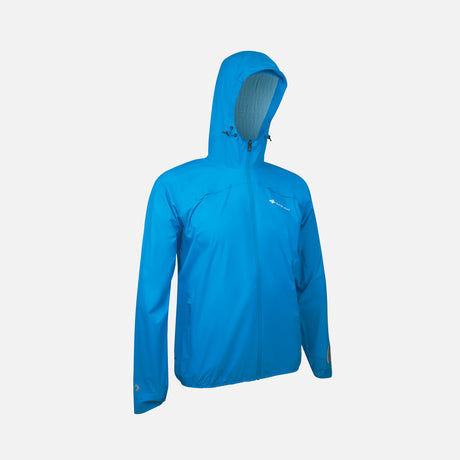
To choose a waterproof trail jacket, prioritize its waterproof rating, breathability, weight, packability, and design. A 20K/20K jacket already offers high protection for trail and mountain, while a 25K/50K model pushes protection and moisture evacuation further.
The choice then depends on your practice: short outing, long trail, ultra, changing weather, or race with mandatory gear. A suitable jacket must be wearable during effort, easy to carry, and suited to the conditions you’re likely to face.
What is the purpose of a waterproof jacket in trail running?
In trail running, a waterproof jacket mainly protects against rain, wind, and cooling. In the mountains, conditions can change quickly between a climb, an exposed ridge, a descent, or a high-altitude section.
The challenge lies in the effort’s intensity: your body produces heat and water vapor just as you try to keep rain out. A trail jacket must therefore combine waterproofness and breathability.
The membrane limits rain penetration and protects from wind when conditions worsen.
A breathable membrane helps evacuate water vapor produced during effort.
Staying protected from wind and moisture helps limit cooling when intensity drops.
A waterproof jacket is mandatory gear for many races. Always check your race’s specific rules.
Waterproof, water-repellent, or windproof: what’s the difference?
These three terms correspond to different levels of protection. Knowing the difference helps avoid heading out in heavy rain with gear designed only to block wind or resist a few drops.
| Type of protection | Main role | Usage |
|---|---|---|
| Windproof | Limit the effect of the wind | Dry weather, exposed ridge, temperature drop |
| Water-repellent | Repel some of the water on the surface | Humidity, drizzle, or short shower depending on the fabric |
| Waterproof | Prevent water from passing through thanks to a membrane | Rain, mountains, long trail, bad weather |
A water-repellent finish can complement a waterproof jacket but does not replace the membrane. To compare two jackets designed for rain, you need to look at their waterproof rating.
10K, 20K, 25K: how to read the waterproof rating of a trail jacket?
Waterproofing is generally expressed in Schmerber or millimeters of water column. The number indicates the water pressure the fabric can withstand before water passes through the membrane.
10,000 Schmerber. A protection level adapted to various rain conditions depending on exposure duration.
20,000 Schmerber. A high level of protection, suitable for long trail runs, mountain conditions, and uncertain weather.
25,000 Schmerber. Even higher protection for demanding practices and prolonged exposure.
Breathability: why is it essential during effort?
A jacket can effectively block rain but become uncomfortable if it poorly evacuates water vapor. On climbs or during intense effort, sweating increases quickly and moisture can build up inside.
Breathability compares a fabric’s ability to evacuate water vapor. Two main indicators are used: MVTR / MVP and RET.
MVTR / MVP: the higher the value, the more water vapor the fabric evacuates
MVTR or MVP measures the amount of water vapor that can pass through the fabric over a given period. A jacket rated 20K in breathability evacuates more water vapor than a membrane with a lower value under the same measurement protocol.
RET: the lower the value, the more breathable the fabric
RET works the other way around: it measures the fabric’s resistance to water vapor passing through. A low value therefore indicates better breathability.
How to choose a waterproof jacket based on your practice?
The membrane level is a first indication. Weight, compactness, your pack’s volume, and how long you’re likely to wear the jacket help refine the choice.
| Practice | Priorities |
|---|---|
| Short Outing | Lightness, compactness, protection suited to the expected weather |
| Long Trail | Balance between protection, breathability, and comfort |
| Ultra-trail | Membrane, weight, compactness, mandatory gear, and pack compatibility |
| Mountain | Protection Against Rain, Wind, and Cooling |
For a race, always check the rules of the specific edition before choosing your jacket. Equipment requirements can vary depending on the event and weather conditions.
Details to Look Beyond the Membrane
Two jackets with similar waterproof ratings can serve different uses. Several design elements have a direct impact on the trail.
The Hood
A well-fitted hood protects your head and limits water entry around the collar. Check its adjustment and stability while running.
Compatibility with the Pack
Some jackets have a gusset allowing them to be worn directly over a trail pack. This solution lets you react quickly when rain arrives without having to remove your pack.
The allowed volume can become a real selection criterion: for example, the ULTRALIGHT 3.0 MP+® fits a pack up to 12L, while the TOP EXTREME ULTRA MP+® has a gusset compatible with packs up to 18L.
Weight and Compactness
A jacket often spends more time in your pack than on your shoulders. On long and ultra trails, its weight and packed volume matter as much as its comfort when worn.
Pockets and Access
The number of pockets, their placement, and accessibility with a pack can make a difference. Some jackets designed for ultras also add specific openings to access flasks without removing the protection.
Cut and Freedom of Movement
The jacket must follow the movements of your arms and upper body when climbing, descending, and using poles. It also needs to stay comfortable with the different layers you wear underneath.
Which Raidlight Waterproof Jacket Should You Choose?
The TOP EXTREME MP+®, TOP EXTREME ULTRA MP+®, and ULTRALIGHT 3.0 MP+® meet three different needs. The TOP EXTREME focuses on simple and effective 20K/20K protection, the TOP EXTREME ULTRA adds features specific to long distances, while the ULTRALIGHT 3.0 pushes further the search for lightness and breathability.
| Model | Membrane | Weight | Pack gusset | Orientation |
|---|---|---|---|---|
| TOP EXTREME MP+® | 20K / 20K | 200 g in M | — | 20K/20K protection, trail and ultra |
| TOP EXTREME ULTRA MP+® | 20K / 20K | 225 g in M | Up to 18L | Ultra, large pack, and hydration access |
| ULTRALIGHT 3.0 MP+® | 25K / 50K | 175 g | Up to 12L | Lightweight, compact, and breathable |
TOP EXTREME MP+® 20K/20K: simple and effective protection
The men's TOP EXTREME MP+® features a 20K/20K membrane and a listed weight of 200 g in size M. It is ultra-trail certified and offers a compact solution for waterproof and breathable protection on the trail.
A compact waterproof jacket equipped with a 20K/20K membrane for trail and ultra.
Consider this if you primarily want 20K/20K protection with a low weight.
See the TOP EXTREME MP+®
TOP EXTREME ULTRA MP+®: designed to run with a pack up to 18L
The TOP EXTREME ULTRA MP+® keeps a 20K/20K membrane but adds several features directly linked to ultra-trail. It weighs 225 g in size M and has a zippered gusset allowing it to be worn over a pack up to 18L.
Front openings allow hydration access when the jacket covers the pack. It also features two zippered pockets, a watch window, an adjustable hood, and elastic waist tightening.
The jacket can be packed into its right pocket. A snap button at the front also keeps the jacket in place when partially open in strong wind.
A jacket developed for ultra with a generous gusset and front hydration access when worn directly over your pack.
Best if you run with a large pack and want to put on your jacket without losing access to your flasks.
See the TOP EXTREME ULTRA MP+®
ULTRALIGHT 3.0 MP+® 25K/50K: 175 g and gusset up to 12L
The ULTRALIGHT 3.0 MP+® features a 25K/50K membrane weighing 175 g. Its gusset allows it to be worn with a trail pack up to 12L.
Its design is clearly focused on reducing weight and bulk, with waterproofing and breathability values higher than the two TOP EXTREME models presented here.
A lightweight, compact jacket with high protection and breathability, equipped with an expandable section compatible with a pack up to 12L.
Recommended if weight, packability, and breathability are your top priorities.
See the ULTRALIGHT 3.0 MP+®
TOP EXTREME, TOP EXTREME ULTRA, or ULTRALIGHT 3.0: which one to choose?
For compact 20K/20K protection and trail/ultra use without needing an expandable section for a large pack.
For ultra with a pack up to 18L, especially if you want to keep direct access to your hydration.
To reduce weight and bulk while benefiting from a 25K/50K membrane and an expandable section up to 12L.
How to care for a waterproof trail jacket?
Care must follow the instructions on the garment’s label. A waterproof jacket usually doesn’t need washing after every outing: airing it out and letting it dry properly already helps space out washes.
When washing is necessary, use a cycle suited for technical clothing and avoid products that could damage the membrane or water repellency.
Close zippers, empty pockets, and check the garment’s specific instructions.
Use a gentle cycle and a product compatible with technical fabrics.
Follow the manufacturer's recommendations to preserve the membrane and fabric treatments.
In short: how to choose the right trail jacket?
To choose a waterproof trail jacket, first compare waterproofness and breathability. Then look at its weight, packability, fit, and compatibility with your pack.
At Raidlight, the TOP EXTREME MP+® offers 20K/20K protection in a compact format. The TOP EXTREME ULTRA MP+® keeps this membrane and adds an expandable section up to 18L as well as hydration access. The ULTRALIGHT 3.0 MP+® drops to 175 g, upgrades to 25K/50K, and fits a pack up to 12L.
The choice therefore directly depends on your gear: backpack volume, desired level of protection, time spent wearing the jacket, and how much you care about weight.