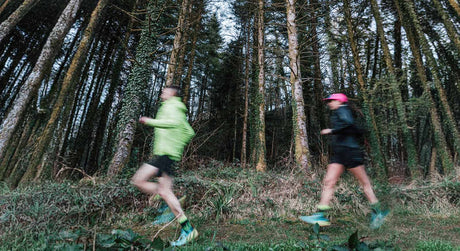
Which trail shoe should you choose? The 3 key questions to ask yourself
“Which trail shoe should you choose?” It’s THE question every trail runner asks, whether beginner or experienced. And for good reason: a good pair is the perfect combo of comfort, grip, and stability. A bad one… means guaranteed struggle on the trails.
The choice depends on several criteria: your goal, the distance you’re aiming for, the terrains you frequent, your build, and your training frequency. We help you see clearly, step by step.
1. What is your goal?
✔️ Are you starting out? Choose a versatile, comfortable, and lightweight pair.
✔️ Do you run regularly? Go for models with more support and reinforcements.
✔️ Want to perform in races? Opt for a dynamic, precise, and lightweight shoe to maximize your output.
2. What distance will you run?
Short distance (under 20 km)
👉 A reactive, thin, and lightweight shoe like the Dynamic 3.0. Perfect for grip and quick accelerations.
Medium distance (20 to 50 km)
👉 The Revolutiv 3.0: a balanced shoe, with a neoprene sock for support, 6 mm lugs for traction, and good dynamism.
Long distance / Ultra (over 50 km)
👉 Comfort, protection, and cushioning are key. The Ultra 4.0 is designed to handle the kilometers and keep you comfortable till the end.
⚠️ Whatever your choice, always prioritize comfort. Your foot must be well supported, without pressure points or rubbing (especially downhill!).
3. On what type of terrain do you run?
Muddy terrain
👉 Maximum grip required: the Dynamic 3.0 and its 6 mm lugs are unbeatable.
Snow
👉 Reinforced protection + grip: add trail gaiters to stay dry and prevent snow from getting into your shoe.
Varied terrain
👉 Choose a flexible, lightweight, and versatile shoe. 4 mm lugs are enough for grip.
Rocky / mountain terrain
👉 You need a stiff sole for stability + reinforcements for protection. The Dynamic 3.0 is ideal.
The little details that make all the difference
💡 Waterproof socks: essential if you run in wet conditions or rain. Our waterproof trail socks keep your feet dry while letting them breathe.
💡 Choose half a size bigger than your usual size: it prevents impacts on descents.
💡 Adapt your choice to your build: more weight = more cushioning. Light build? You can go for a more minimalist option.
Advice from our R&D manager:
“A trail shoe must adapt to the nature of the terrain: stability, grip, protection… Nothing is left to chance. Good support over the top of the foot also means more precision in your stride and less rotation on unstable ground.”
Useful definitions
*Drop: height difference between the heel and the front of the foot. The higher the drop, the more the support is oriented towards the heel.
*Cushioning: the sole’s ability to absorb shocks. The more cushioning, the less your muscles and joints take the impact.